


In our previous chapter, we explored the architecture of open civic systems — how they transform institutions, incentives, and infrastructure to create the conditions for distributed coordination. We saw how the Three Horizons framework helps us distinguish between innovations that prolong dysfunction (H2-) and those that create enabling conditions for an entirely new paradigm (H2+).
Now we arrive at the practical heart of the matter: how do we actually build these systems? What principles guide their design? How do we know if they’re working? And what does it mean to integrate these human systems with the patterns of living systems themselves?
Prefer to read the full thesis? Read a PDF

System Design Principles
Source: Wiki
As civic innovators build and deploy open protocols, civic utilities, and civic stacks that collectively form the civic hyper-structure of an open civic system, the following principles will be vital to ensure the strategic viability of such approaches. These characteristics or qualities are critical to ensure both theoretical and practical alignment with the open civic system design philosophy.
Modular refers to the design principle whereby a system is divided into separate, self-contained units or modules. Each module can function independently but can also be combined with other modules to create a more complex system. This approach allows for flexibility, scalability, and ease of maintenance, as individual modules can be updated or replaced without affecting the entire system. Modularity also empowers local communities to self-assemble their own compositions of various modules to meet their own needs based on their own goals and priorities.
Composable refers to the capability of any modular component of a system to be modified according to various parameters, enabling components to be configured to meet specific needs. In the context of open civic systems, composability allows for the fine tuning of modules to increase their adaptability and customization based on the unique requirements of different communities or projects.
Inclusivity ensures that the system is accessible and usable by all individuals, regardless of their background, abilities, or circumstances. In open civic systems, inclusivity involves designing with diverse user needs in mind, promoting equity, and ensuring that everyone can participate in and benefit from the system. This includes considerations for accessibility, language, and cultural relevance.
Interoperable describes the ability of different systems, organizations, or components to work together seamlessly. In open civic systems, interoperability ensures that various modules or platforms can exchange information and function together effectively, regardless of their underlying technologies or architectures. This is crucial for creating cohesive and efficient civic hyper-structures.
System Design Ethics
Source: Wiki
The end goal of open civic systems is not simply a mental exercise in alternative systems design. Open civic systems are inherently designed to increase the capacity for self-correction that would directly empower citizens to move towards health and wellbeing.
To evaluate the success or failure of any open civic system, a triad of qualitative indicators are necessary as a rubric for a healthy civilization. These heath indicators, or system design ethics, shouldn’t be considered as separate domains but rather as interconnected criteria for holistic evaluation of systemic adaptation and design.
Resilience
Resilience is the state and the capacity for adaptive self-organization sufficient to provide core life support function across changing world circumstances.
As things change over time, resilience ensures we have the ability to adjust and adapt without compromising our essential needs. The philosophy of decentralization is inherent to the philosophy of resilience, because centralized structures are fragile and non-adaptive whereas decentralized structures are modular, adaptive, and redundant to ensure their ongoing function as circumstances stress the integrity of a system. For example, imagine compostable bioplastic 3D printer micro manufacturing to minimize dependencies on international industrial supply chains. The creation of decentralized local infrastructure allows us to more easily meet needs locally and adapt to change.
Examples of indicators of resilience include:
Diversity
Redundancy
Adaptive Capacity
Interconnectivity
Choice
Choice is the state of fundamental respect for the sovereign agency of all beings and the capacity of individual agents to express their agency and influence their circumstances.
Designing for choice compels us to design systems that support agency, not constrict or take it away. Systems of self-definition are systems in which agents opt-in and choose how they want to participate. Choice also implies that agents have the ability to assert their will and change their situation if they are not satisfied or fulfilled. In Elinor Ostrom’s foundational work on governing the commons, she states that people who are affected by a governance structure should be able to participate in it and modify it. Choice is fundamental because unless all agents are able to participate in the design and application of our systems, systems designers may leave out critical capacities and inclusions by not consulting or engaging with particular communities, producing unhealthy cultures of dominance.
Examples of indicators of choice include:
Opt-in and opt-out mechanisms
Flexible participation levels
Participatory decision making
Feedback and conflict resolution mechanisms
Modularity and composability
Access to information and data self-custody
Vitality
Vitality is Life’s capacity to create more Life, the embodied state of thriving that emerges from the interconnected levels of well-being and quality of life for individuals, communities, and ecologies.
Vitality is based on the indigenous Quechua principle of Sumak kawsay, which means “I am well because you are well”. This implies that our ecological, communal, and individual thriving are bound together. For truly holistic thriving to occur, a system must concern itself with the all interconnected scales and expressions of wellbeing.
Examples of indicators of vitality include:
Cultural diversity
Engagement
Community vitality
Ecological diversity and resilience
Living standards
Psychological well-being
Self-reported physical health
Use of time
Education
Stigmergy: The Nature Of Open Civic Systems
Source: Wiki
Across the natural world, we can see examples of nature engaging in positive sum feedback loops in which plants, animals, fungi, bacteria, water, light, and soil exchange energy and information for mutual benefit. The sum total of these interactions is the “web of Life,” a nested set of relationships that form a complex adaptive system that is self-regulating, self-healing, self-reinforcing, and continuously evolving.
“The concept of stigmergy has been used to analyze self-organizing activities in an ever-widening range of domains, including social insects, robotics, web communities and human society. Yet, it is still poorly understood and as such its full power remains under-appreciated. This paper… [defines] stigmergy as a mechanism of indirect coordination in which the trace left by an action in a medium stimulates subsequent actions… [Stigmergy] enables complex, coordinated activity without any need for planning, control, communication, simultaneous presence, or even mutual awareness. The resulting self-organization is driven by a combination of positive and negative feedbacks, amplifying beneficial developments while suppressing errors. Thus, stigmergy is applicable to a very broad variety of cases, from chemical reactions to bodily coordination and Internet-supported collaboration in Wikipedia.”
– Stigmergy as a universal coordination mechanism I: Definition and components by Francis Heylighen
Stigmergy is a type of swarm intelligence in which individual agents, taking their own actions, signal those actions to other agents in such a way that other agents can contribute in a positive sum feedback loop. Examples of stigmergy in non-human organisms include ants, termites, bees, flocks of birds, bacteria, and slime mold. In humans, we can see examples of stigmergy in Burning Man, open source software development, Wikipedia, the Occupy movement, and various internet experiments. More akin to jazz music or an improv troupe than an institution or organization, stigmergy uses a simple set of decentralized rules to support individual agents in contributing to mutually beneficial goals. What is lost in terms of the linear clarity derived from centralized planning and control is greatly outweighed by the unplannable complexity and beauty of a swarm contributing their unique gifts towards an emergent structure.
Stigmergy is made possible by the decentralized rule set that all agents choose to abide by, creating the conditions for feedback loops that reward positive sum behaviors. At Burning Man, these rules are the boundaries of the city and the grid of city streets as well as the 10 Principles that are upheld by peer accountability. In jazz, these rules are music theory, rhythm, and tuning. In Wikipedia, these rules are based around editorial review, appropriate citation, grammar, and dynamic linking between related concepts. In improv comedy, these rules are “yes, and,” narrative development, and the building/release of comedic tension.
In all of these instances, the positive sum feedback is mostly driven by contributions and alignment. Contributions that attract more contributions feed back on themselves. These rewards are intrinsic to participation. No one needs to direct or command them to occur. When it is clear how to contribute without stepping on someone else’s toes (literally or metaphorically), humans naturally want to converge around shared efforts in which their participation is meaningful and purposeful. This is a form of participatory commons governance in the sense that it empowers us to collectively steer the ship of a common effort through our contribution instead of through our top down control of others’ agency.
Open civic systems create scaffolding for stigmergic coordination by providing open templates for agent-centric coordination. Institutional functions and all other functions of a society are ultimately based in human coordination, making open civic systems capable of achieving the same outputs as any centralized institution. Open protocols, the DNA or source code for open civic systems, function similarly to the pheromone pattern languages of ants that inform how agents communicate and stack their contributions. In this way, open civic systems integrate human social systems with the patterns of living systems.
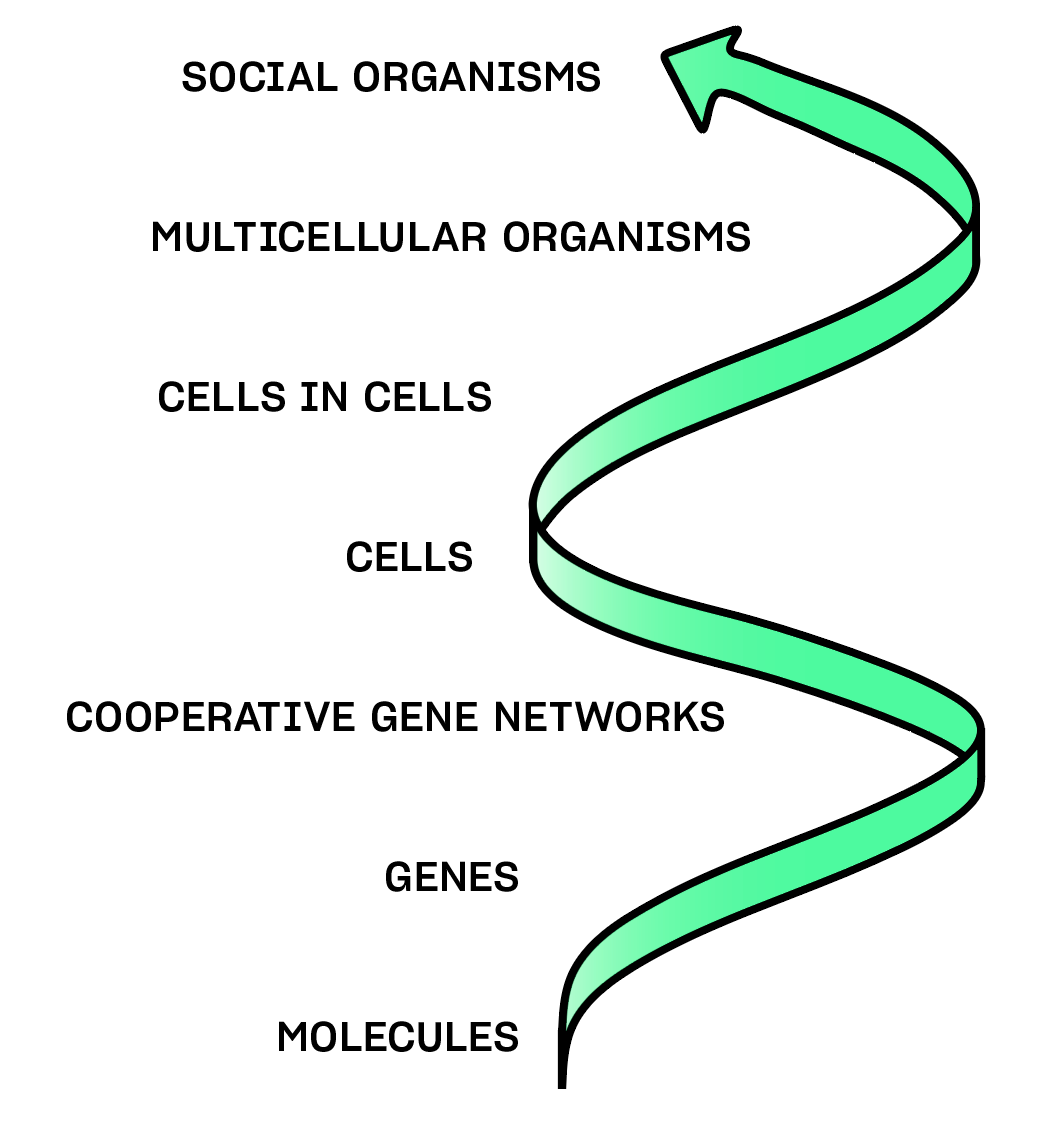
In the same way that an ant colony or bee hive can be considered a macroorganism, an emergent whole with its own form of collective agency, a human social organism is the equivalent design pattern for human coordination. Social organisms grow out of a core mission, vision, and culture that is defined in the nucleus of the social organism’s social DNA. This social DNA serves as a north star as it is encoded and reproduced by agents through means of peer accountability, empowering human agents to opt-in to social organisms with whom they align at the fundamental DNA level. This core DNA also informs the functions, roles, flows, and membranes that are required for the social organism to achieve its purpose within its social ecology. Distinct from institutions or corporations that tend to function as a kind of “zombie” or cancerous social organism, never dying or engaging in reciprocal flows with their environment, social organisms are intended to be conceived, gestated, matured, and decomposed as the entire social ecology continues to evolve and transform to reflect the needs and desires of the many generations of agents who animate them.
While this fundamental transformation in human social behavior and structure is profound, it reflects patterns that exist all around us in the natural world. A human civilization based on these fundamental design patterns would represent a truly open civic system, able to easily adapt to changing circumstances, respond to collectively determined needs, and provide cosmo-local feedback cycles in which the collective superorganism of humanity could continuously learn and grow as peers.
Polycentricity: Holons Of Self-Organization
Source: Wiki
Embracing the living systems view of the interrelatedness and complexity present in our ecologies, and perhaps our future human systems, we begin to view components of a system as nested wholes or holons.
“A holon is something that is simultaneously a whole in and of itself, as well as a part of a larger whole. In this way, a holon can be considered a subsystem within a larger hierarchical system” – Wikipedia
This fractal perspective allows us to view the world through the lens of polycentricity, a way of seeing that can contextually shift depending on which holon we’re seeking to understand. Because each component is a whole unto itself within a fractal web of relationships, polycentricity emerges as a way of engaging with the sovereign sphere of each holon while acknowledging that a complex system will contain many component parts which are themselves sovereign wholes. This whole systems approach allows us to engage with and design human systems that reflect the various interconnected holonic scales of a complex system, from the sub-atomic to the molecular, cellular, organismic, social organismic, ecological and biospheric scales. At each scale, the autonomy and healthy reciprocal flows within and across each holon will affect the health of the system.
This living systems understanding is reflected in political philosophy through the principle of subsidiarity, an idea which emerged out of the natural law philosophy of Thomas Aquinas and the neo-Calvinist political philosophy of “sphere sovereignty,” which states that “social and political issues should be dealt with at the most immediate or local level that is consistent with their resolution.”
Alexis de Tocqueville‘s Democracy in America offers a description of the principle of subsidiarity in early America. Tocqueville observed that “decentralization has, not only an administrative value, but also a civic dimension, since it increases the opportunities for citizens to take interest in public affairs; it makes them get accustomed to using freedom. And from the accumulation of these local, active, persnickety freedoms, is born the most efficient counterweight against the claims of the central government, even if it were supported by an impersonal, collective will.”
While 21st century American democracy has fallen claim to profound centralization and regulatory capture, the same spirit that Tocqueville noted in early America is being revitalized and reimagined in a contemporary context through the reemergence of the bioregional movement. A bioregion is defined as “an ecologically and geographically defined area that is smaller than a biogeographic realm, but larger than an ecoregion or an ecosystem, and is defined along watershed and hydrological boundaries,” and the bioregional movement is an emerging social effort to reorganize our civic participation in the context of a whole systems approach to regenerating our bioregions.
A beautiful living example of a cosmo-local and polycentric approach to whole systems thinking, bioregionalism embraces the holonic nesting of our belonging to and embeddedness within our living systems. Thinking bioregionally shifts our perspective towards the holonic nature of our relationships. Instead of seeding a new kind of nationalism wherein the locus of power and identity is an abstract nation state, bioregionalism sees humanity as part of a single biosphere and global human community while localizing our actions at the scale at which closed loop systems are most needed and relevant. In this sense, bioregionalism and a living systems view of civic infrastructure are one and the same.
Blockchain: Peer To Peer Cybernetics
Source: Wiki
To build the infrastructures of open civic systems that align with this holonic and polycentric view, new technological substrates are needed. Although the early stages of the internet were defined by peer to peer interactions between academic institutions, our digital commons was quickly captured by centralized “web2” entities like Google and Meta who realized that by placing essential internet services on their own servers, as opposed to self-hosted ones, they could extract attention and advertising revenue. What followed was a classic multi-polar trap in which misaligned incentives and the enclosure of our digital commons led to a race to the bottom in which the monetization of our attention became an arms race between increasingly monopolistic tech giants. At the core of these dynamics is the infrastructural failure of the “client-server” model which prevents users from interacting with one another outside of a centrally mediated context.
To both address these dysfunctional system dynamics as well as to create alternative systems, it becomes necessary to develop decentralized technological substrates in which users may interact with one another peer to peer and produce novel forms of autopoetic self-governance that are not possible within centralized technology platforms. Blockchains are one such technological substrate which leverage the power of encryption and competition between nodes in a network to secure an immutable ledger of interactions, maintaining trust between parties without relying on a centralized structure. While not without fault or its own forms of centralized capture, blockchains – and similar P2P technology – represent a significant step towards a technological substrate for civic infrastructure that supports composability and interoperability.
Emergent System Capabilities
Source: Wiki
This design approach to open civic systems is directly connected to the development of open source software, applying the same methodologies for social systems. Coherence and consensus in this stigmergic and evolutionary landscape is determined based on swarm intelligence and the utility of the outputs themselves.
As the system evolves, patterns that produce positive outcomes will be selected, with forking and merging of patterns achieving the same effects as genetic mutation and reproduction. Through an open protocol pattern language, these learnings and evolutionary adaptations can be cosmo-locally shared and integrated, allowing humanity to learn together how best to design and deploy open civic systems.
These types of network effects and swarm dynamics are not possible through centralized approaches, but they are also potentially fragile unless the underlying signaling pathways are clearly defined and mutually established. Consensus is not necessary in the pluralistic approach to specific instances of the pattern, but strong consensus is necessary at the level of the meta-pattern in order for the evolutionary dynamics to take effect.
As civic innovators, patrons, and organizers align and coordinate as a community of practice, novel capacities emerge as the cumulative effects of networked civic utilities are developed. The gravity of this alignment and coordination gradually pulls legacy systems and human attention from one basin of attraction to another. This collective effort also produces the emergent effect of scenius, an acceleration of creative capacity through the dynamic interplay and exchange between aligned innovators. The strength of these feedback loops produces rapid iteration, participatory co-design, and addresses the blind spots created when centralized groups attempt to impose their vision or process on those they intend to serve.
If humanity can align around open civic innovation models, our collective intelligence can be harnessed to collaboratively compose the civilization that we share.
We’ve now traced the living architecture of open civic systems — from their ethical indicators to their stigmergic dynamics, from polycentric holons to peer-to-peer cybernetics. We’ve seen how human coordination, when designed in alignment with living systems principles, can become adaptive, regenerative, and self-correcting rather than extractive and brittle.
What emerges from this view is not a single blueprint, institution, or ideology — but a pattern language for collective becoming. Open civic systems do not prescribe outcomes; they cultivate conditions. They do not centralize control; they scaffold agency. They do not demand belief; they invite participation.
And yet, none of this happens automatically.
Frameworks do not build themselves. Protocols do not enact themselves. Culture does not regenerate itself without choice. At every scale — from the individual to the bioregion to the planetary commons — the future remains contingent upon the decisions we make together.
Which brings us, inevitably, to the only question that truly remains.
Series:
Chapter 9: Open Civic Systems — Architecture & Transformation
Chapter 10: Open Civic Systems — Design Principles & Living Systems ← This Chapter
Chapter 11: Our Choice