


We’ve now mapped the three attractors: chaos, authoritarianism, and distributed coordination. We understand that the third attractor requires self-correcting feedback loops, aligned incentives, and a revitalized civic culture. But why should we believe such a future is possible? Isn’t this just naive idealism?
This question deserves a serious answer. The vision proposed in this thesis is inherently audacious — it invokes a radical reimagining of human society rooted in love, care, and mutual responsibility. Such audacity is required to shift what’s perceived as possible. But this isn’t utopian fantasy; it’s what we call “post-tragic protopian audacity.”
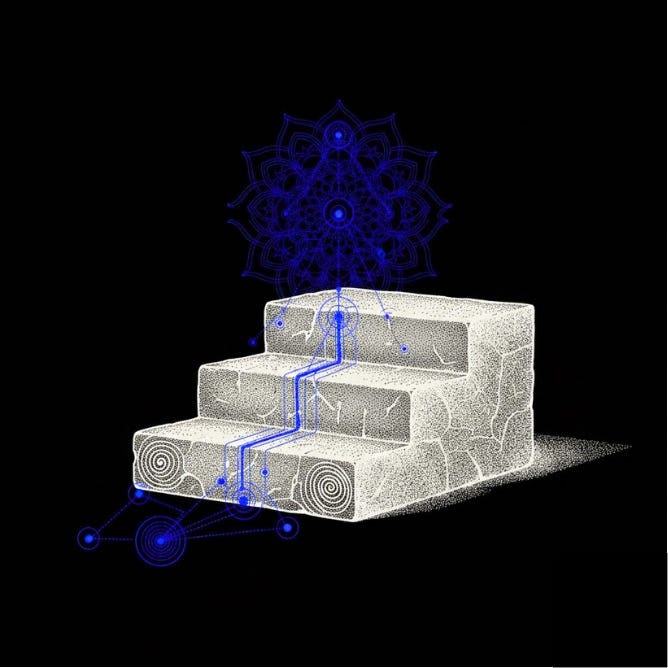
A Post-Tragic Protopian Audacity
Source: Wiki
This proposed vision of possibility is inherently audacious. It invokes a radical reimagining of a human society rooted in love, care, and mutual responsibility. Such an audacious act of imagination is required to shift the overton window of perceived possibility. One of the greatest tools of manipulation used by systems of power is the belief that our current socio-economic order is a reflection of reality itself. A close examination of the natural world reveals that it is, in fact, cooperation and synergy that defines the success or failure of a species in the evolutionary process. This is also true of the evolution of human civilization.
overtone window
The range of policies and ideas that are considered politically acceptable to the mainstream population at any given time. Named after Joseph Overton, a policy analyst, this concept illustrates how public opinion shapes what politicians can propose and support without appearing too extreme.
The window can shift over time as societal norms and values change, allowing previously radical ideas to become mainstream and vice versa. Essentially, it defines the boundaries of acceptable discourse in the political landscape.
imagination activism
According to Moral Imaginations, imagination activism involves expanding and exercising one’s imagination to broaden ways of thinking and envisioning what is possible and achievable. An imagination activist not only enhances their own imaginative capacities but also equips themselves with tools, questions, and exercises to help others expand their imaginations. This approach aims to shift perceptions and translate new ways of thinking into actionable changes.
This thesis emerged from direct experiences of awakening to a sense of the suffering of our world, a gradual and ongoing process of removing the veils of indoctrination to perceive the massive scale of violence, inequality, and injustice upon which our current society is based. Entering the trough of disillusionment as understanding of the depth of the crisis increases, it can be easy to choose either the path of dissociation and numbing or total annihilating grief. Both choices are entirely reasonable given the scale and profound tragedy of loss of human life and the mass extinction of other species, but a third response, holding the grief and possibility simultaneously, is also available. The post-tragic aesthetic and sensibility emerges through the embrace of our grief and empathy as fuel for our creative action. We are motivated to reimagine our world not in spite of our current tragedies but because of them. Similarly, solar punk and lunar punk as aesthetic and cultural movements have emerged as similar expressions of the dynamic balance between radical optimism and sobering realism in the face of extreme crises.
system equilibrium
In the context of social, economic, and political systems refers to a state where all forces and influences within the system are balanced, resulting in stability and no net change over time.
synergy
The interaction or cooperation of two or more organizations, substances, or other agents to produce a combined effect greater than the sum of their separate effects. This concept is often used in business, science, and other fields to describe how collaborative efforts can lead to enhanced outcomes that wouldn’t be possible individually.
The radical reimagining of our human society emerges as an act of rebellion against the prevailing lack of socio-political imaginary that insists that capitalism is the only viable political and economic “forever” system. But unlike utopian claims that are usually driven by a single individual’s imagined design of alternative socio-economic frameworks, the radical reimagining proposed by this thesis instead offers a set of mechanisms and processes by which we may collectively dream and enact a new world into being.
post-capitalist
A hypothetical or emerging state of society and economy that exists after the decline or end of capitalism. In a post-capitalist society, traditional capitalist structures, such as the reliance on private ownership of the means of production and the pursuit of profit, are replaced by alternative systems.
Protopia, a term coined by futurist Kevin Kelly in 2009, refers to a society based on incremental and mutually determined progress. By taking incremental steps forward together, grounded in our direct experience of reality and the collectively determined needs of our immediate communities, we are carving out alternative, imaginal spaces in which we can collectively dream and create a different kind of society together. Instead of proposing a utopian vision of how human society should organize itself, this thesis offers the OpenCivics Innovation Framework as a methodology for the distributed and collective process of civilization-scale transformation.
This transition will likely take place across a multi-generational time span before we arrive at a new, stable, system equilibrium, and it is a near certainty that the process will be disruptive and tenuous at points, but our audacity to dream of a more beautiful world as our current civilization degrades around us is the first step in that multi-generational process.
post-tragic
The term post-tragic refers to a state or condition that emerges after experiencing a tragic event. Unlike the concept of post-traumatic, which often focuses on the lingering negative effects and trauma, post-tragic emphasizes a transformative process. It involves moving beyond the initial suffering and finding meaning, growth, or a new perspective as a result of the tragedy. This concept is often used in literature, psychology, and philosophy to describe how individuals or societies can evolve and find resilience after profound loss or hardship.
Our hearts have been broken thousands of times as we have felt and been transformed by the suffering of our world. The impulse to care and respond to this suffering is a natural response as empathic and social beings, a response that has been denatured by our social conditioning, wounding, and reliance on bureaucratic institutions to care for the collective on our behalf. Liberating this natural impulse to care for humanity and our world is the great work of these challenging times. Our choice to open our hearts after being let down again and again by our leaders and systems is a courageous one, but a more beautiful world can only emerge when we rise up together as a human species, facing the suffering of our world with compassion and wise action. We have the tools, methods, and frameworks ready at hand. From that place, an open civics is a call to awaken the spirit of care and compassion in the public and encode the spirit of non-rivalrous coordination among civic innovators, such that humanity can rise up together to collectively reimagine our world.
Opening our hearts after being let down again and again by our leaders and systems is a courageous choice. But a more beautiful world can only emerge when we rise up together, facing the suffering of our world with compassion and wise action. In our next email, we’ll explore open civic culture — the foundational cultural transformation that makes distributed coordination possible. This isn’t just about building new systems; it’s about regenerating the social fabric itself.
Series:
Chapter 7: A Post-Tragic Protopian Audacity ← This Chapter
Chapter 8: Open Civic Culture
Chapter 9: Open Civic Systems — Architecture & Transformation
Chapter 10: Open Civic Systems — Design Principles & Living Systems
Chapter 11: Our Choice